
What Is a Dummy Ticket? Meaning, Uses, Validity & Visa Acceptance Explained
If you’ve ever prepared a visa application, you’ve probably run into a requirement for “proof of onward travel” or a “flight itinerary” — and quickly discovered that buying a full, non-refundable ticket before your visa is even approved feels like an unnecessary gamble. That’s exactly the gap a dummy ticket fills. This guide covers everything from the basic meaning of the term to how validity, verification, and legal safe-use actually work.
In This Guide
|
1. What Is a Dummy Ticket?
|
|
2. Dummy Ticket, Flight Reservation, Paid Ticket, Fake Ticket — Key Differences
|
|
3. Why Travelers Use a Dummy Ticket
|
|
4. What a Dummy Ticket Actually Proves
|
|
5. What a Genuine Dummy Ticket Should Include
|
|
6. How Long Is a Dummy Ticket Valid?
|
|
7. How Dummy Tickets Are Verified — and Red Flags to Avoid
|
|
8. Dummy Ticket vs Paid Airline Ticket
|
|
9. Common Misconceptions
|
|
10. Other Uses Beyond Visa Applications
|
|
11. How to Get a Verifiable Dummy Ticket
|
|
12. FAQs
|
What Is a Dummy Ticket?
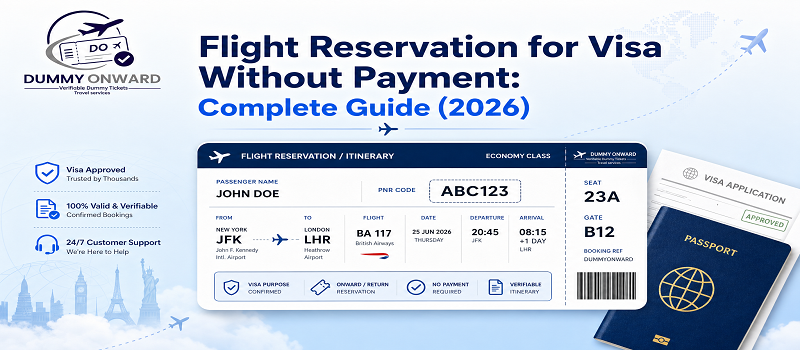
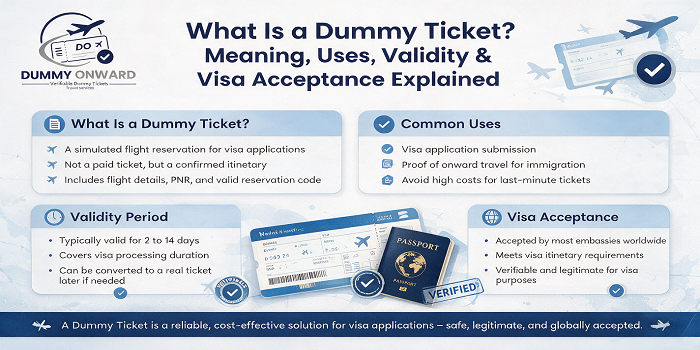
A dummy ticket — also searched as dummy flight ticket, flight dummy ticket, or dummy airline ticket — is a temporary flight reservation or itinerary that shows your planned travel dates, route, and passenger details, without requiring you to pay for a fully confirmed, ticketed airline seat.
It looks and functions like a real flight booking: it carries a PNR (Passenger Name Record / booking reference), an airline name, a flight number, and travel dates. What it does not carry is a completed payment or a confirmed seat assignment for actual travel. Its entire purpose is documentation — showing a visa officer, an airline check-in counter, or an immigration desk that you have a defined, plausible travel plan.
A simple way to frame it: a paid airline ticket says “I am flying on this date, in this seat.” A dummy ticket says “This is my intended travel plan.” For most visa applications and airline onward-travel checks, the second statement is all that’s actually required.
Dummy Ticket, Flight Reservation, Paid Ticket, Fake Ticket — Key Differences
People use “dummy ticket” loosely, and that’s where a lot of confusion comes from. Here’s how the related terms actually differ:
|
Term |
What It Is |
Best Used For |
|
Dummy ticket |
A temporary, real reservation used purely as travel-plan proof |
Visa applications, onward-travel proof at check-in |
|
Flight reservation |
The more formal name for the same concept, often used in embassy checklists |
Same as above — many consulates use this exact phrase |
|
Paid airline ticket |
A fully ticketed, confirmed booking you can actually board |
Real travel, once your visa or plans are confirmed |
|
Fake ticket |
A manually edited or fabricated document with no real booking behind it |
Should never be used — high risk, no verification possible |
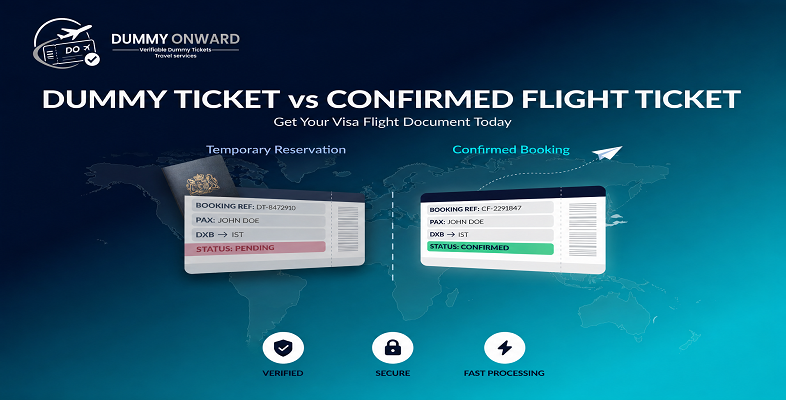
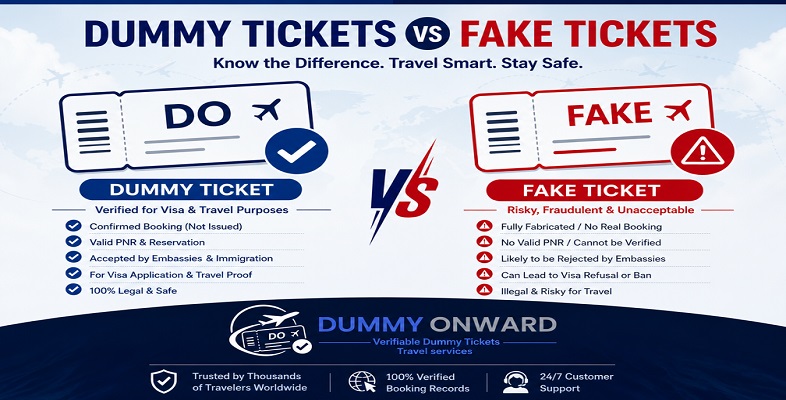
The distinction that matters most: a dummy ticket is a genuine reservation, generated through real airline or GDS booking systems, that simply hasn’t been paid for and ticketed. A fake ticket, on the other hand, is invented — usually an edited PDF with no record anywhere in an airline’s system. Understanding this difference is the single most important thing before you use one for anything official.
Why Travellers Use a Dummy Ticket
The Core Problem: Timing and Financial Risk
Most visa processes create an awkward gap. The embassy wants evidence of your travel plan before they decide on your visa — but buying a full-price, often non-refundable ticket before that decision carries real financial risk. Consider what can go wrong if you buy first:
-
Your visa decision gets delayed past your intended departure date
-
Your visa is refused entirely, and you’re left holding an unusable ticket
-
Your visa is issued for different dates than you originally planned
-
Your appointment gets rescheduled after you’ve already paid for flights
-
Even “refundable” fares often come with restrictive conditions or processing delays
A dummy ticket removes this risk. You get a document that satisfies the “show me your travel plan” requirement without locking in real money before you know the outcome.
Beyond Visas: Airline and Immigration Requirements
Visa applications aren’t the only place a dummy ticket matters:
-
Airlines frequently require proof of onward or return travel before allowing a passenger to board a one-way international flight — especially into countries with strict entry rules
-
Immigration officers at the destination airport may ask for evidence that you intend to leave within your permitted stay
-
Travel agents and visa consultants often build a dummy ticket into standard visa document checklists as a default recommendation
What a Dummy Ticket Actually Proves
It’s important to be realistic about what this document does and doesn’t do. A dummy ticket does not prove you qualify for a visa. It proves a much narrower, specific point: that you have a defined route and travel window.
Entry, Exit, and Duration
The itinerary shows when you plan to arrive and when you plan to leave (or continue onward). This matters because your requested stay length needs to match what’s on the document — if your visa form says 14 days but your itinerary shows 30, that mismatch is a bigger problem than the itinerary itself.
Destination and Route Logic
For multi-country trips (Schengen applications are the classic example), the route can help establish which country is your “main destination” — a factor that determines which consulate should actually process your application.
Purpose Alignment
For business, study, or family-visit visas, your travel dates need to logically support your stated purpose. A business visa itinerary should have you arriving before a conference starts. A student itinerary should align with orientation or term-start dates.
Return or Onward Intent
A return or onward reservation supports (but doesn’t singlehandedly prove) that you intend to leave the destination within your permitted stay. Officers weigh this alongside employment, financial ties, and travel history — a dummy ticket is one input, not the whole picture.
What a Genuine Dummy Ticket Should Include
Not every PDF labeled “flight itinerary” will actually hold up under scrutiny. A dummy ticket that’s built correctly needs:
|
Detail |
Why It Matters |
Common Mistake to Avoid |
|
Full passenger name (exactly as per passport) |
Must match every other document in your file |
Missing middle name, wrong surname order |
|
Departure & destination city |
Should logically match your visa application |
Random routing that doesn’t fit your stated purpose |
|
Travel dates |
Must be consistent with your visa form and hotel booking |
Dates that don’t match your hotel or invitation letter |
|
Airline name & flight number |
Makes the itinerary look and behave like a genuine booking |
Generic or inconsistent airline details |
|
PNR / booking reference |
Should be checkable on the airline’s official site while active |
A static PDF with no real, retrievable reference |
|
Issue date |
Shows the document is current, not stale |
Submitting an old reservation from weeks earlier |
The single biggest red flag reviewers look for is a booking reference that doesn’t retrieve. If your provider can’t guarantee a real, working PNR, treat the document as unreliable — regardless of how polished the PDF looks.
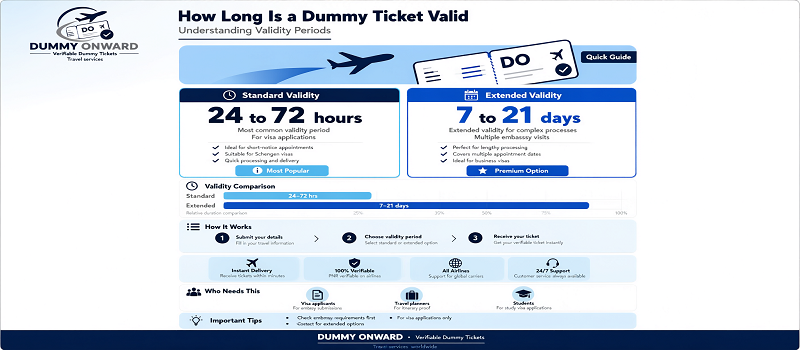
How Long Is a Dummy Ticket Valid?
Validity depends on the reservation type, the airline’s own booking system, and the provider’s process — there’s no single universal answer. Most dummy tickets stay checkable for a short, defined window, commonly ranging from a few days up to a couple of weeks, depending on the airline and fare class used to generate the hold.
Practical rule of thumb: request your dummy ticket close to when you actually need it — right before a visa submission, embassy appointment, or airline check-in — rather than far in advance. If your visa process ends up taking longer than expected, ask your provider for a refreshed itinerary with updated dates instead of submitting an expired one.
When Should You Refresh It?
-
Your appointment or interview date has moved
-
The original PNR is no longer checkable
-
The consulate specifically requests fresh, updated proof
-
Your travel dates changed for any other reason (host invitation shifted, hotel dates changed, etc.)
A refresh should preserve the same overall trip — same destination, similar duration — unless your actual plans changed. Redesigning the whole itinerary on every refresh can make an application look inconsistent.
How Dummy Tickets Are Verified — and Red Flags to Avoid
Not every application gets the same level of scrutiny. Some reviewers do a quick consistency check (do the dates match your other documents?). Others actively verify the PNR through the airline’s official channel. Because you can’t predict which applies to your case, always assume verification is possible and build accordingly.
Red Flags That Get Applications Flagged
-
No booking reference, or one that doesn’t retrieve on the airline’s website
-
Passenger name that doesn’t exactly match the passport
-
Airport codes that don’t correspond to the stated cities
-
Flight times or layovers that are physically implausible
-
Return or onward date that conflicts with your hotel booking or invitation letter
-
A document with visibly copied branding or inconsistent formatting
-
A provider that claims “guaranteed visa approval” — no document can promise this
The strongest dummy ticket is, honestly, a boring one: an accurate name, a sensible route, matching dates, and nothing that invites extra questions.
Dummy Ticket vs Paid Airline Ticket
|
|
Dummy Ticket |
Paid Airline Ticket |
|
Cost |
Low, flat fee |
Full airfare |
|
Valid for boarding |
No |
Yes |
|
Refund risk if plans change |
None — nothing was paid |
Often high, depending on fare rules |
|
PNR / booking reference |
Yes, checkable, not ticketed |
Yes, fully ticketed |
|
Best use |
Documentation — visa, onward-travel proof |
Actual travel once plans are confirmed |
|
Delivery time |
Minutes |
Instant to a few hours |
For a deeper breakdown of when to use each, see our dedicated guide: Dummy Ticket vs Confirmed Ticket.
Common Misconceptions About Dummy Tickets
“A dummy ticket is the same as a fake ticket.” Not true — a genuine dummy ticket is a real, temporary reservation with a checkable PNR. A fake ticket is fabricated with no booking behind it at all.
“A dummy ticket guarantees visa approval.” No travel document guarantees a visa outcome. Approval depends on many factors — funds, purpose, ties to your home country, and overall application consistency.
“No one actually checks these.” Some applications receive only a light consistency check, others involve active PNR verification. Always build the document as if it will be checked.
“More flight detail always looks better.” Not necessarily. A simple, direct route that matches your stated purpose is stronger than an overly complex multi-city itinerary that raises unnecessary questions.
Other Uses Beyond Visa Applications
While visa documentation is the most common use case, dummy tickets also come up in:
-
Airline check-in for one-way tickets — many airlines require proof of onward travel before boarding, especially for destinations with strict entry requirements
-
Immigration checks at arrival — some border officers ask for evidence of intended departure within the permitted stay
-
Digital nomads and long-term travelers — used as a temporary placeholder while finalizing the next leg of an ongoing trip
A visa-purpose dummy ticket isn’t automatically guaranteed to satisfy every airline’s boarding policy — always confirm the specific airline’s requirement if you’re using it for check-in rather than a visa file.
How to Get a Verifiable Dummy Ticket
At Dummy Onward, we generate genuine, verifiable dummy tickets — real, checkable PNRs, not static images or edited PDFs — starting at just $3 / ₹249, delivered within 10–20 minutes. Our team also provides free basic travel and visa documentation guidance if you’re unsure what your specific application checklist requires, with support available 24x7.